Predictive Maintenance with Sensor Fusion.
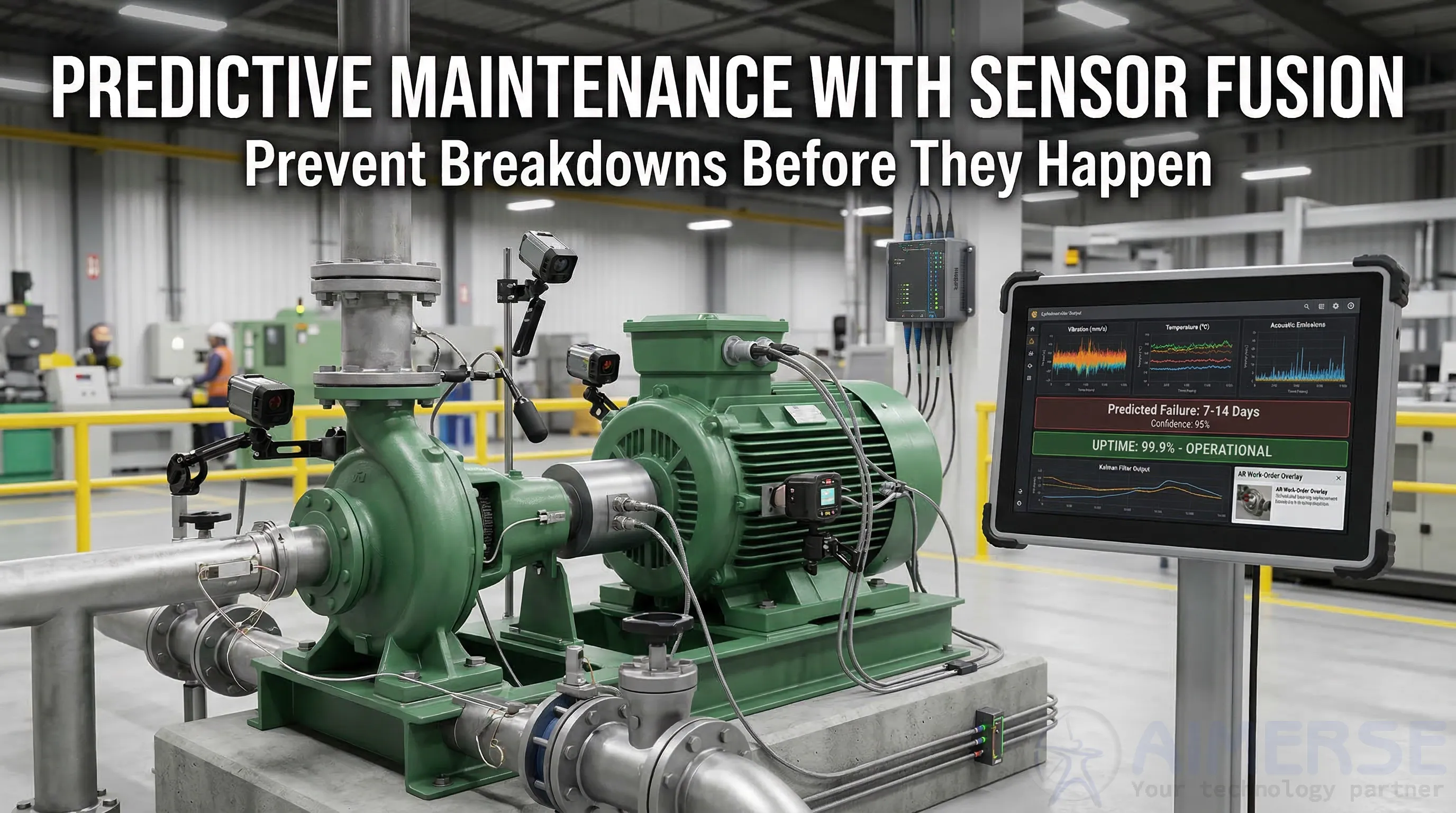
The sensor fusion combines the data from vibrations, heat, and sound to predict equipment failures with high confidence in Industry 4.0, i.e., 2026. By using accelerometers to detect vibrations, infrared cameras to detect heat, and microphones to detect sound, and then applying a Kalman filter or ML, we can detect equipment failures a week to ten days in advance. GE Predix highlights instances of increased uptimes and savings in costs per machine annually.
Fusion methods
- Using Kalman and Particle filters to filter noisy data and provide clean signals
- Using deep learning methods and CNN-LSTM architectures
- Using feature engineering and combining Fourier transforms with quirks
- Using autoencoders to detect anomalies
Tech Stack Touches
- Django for handling data streams.
- Node.js for handling the actual alerting.
Use Cases
- Motors: detects bearing faults 10 days in advance.
- Pumps: detects cavitation issues.
- Turbines: detects thermal stress.
McKinsey estimates savings to be between 10-40% for maintenance costs.
Challenges
- Data drifts.
- Sensor faults.
Roadmap
- Sensors
- Edge
- Cloud
- Augmented Reality
Bottom Line
By 2026, sensor fusion-based predictive maintenance can revolutionize asset management with multi-level intelligence. By using React.js-based live data visualization, Node.js-based data ingestion, Django/Python-based sensor fusion analytics, Laravel-based rapid rollouts, and robust Java Spring Boot-based services, equipment failures can be predicted, and operations can be made to run smoothly.