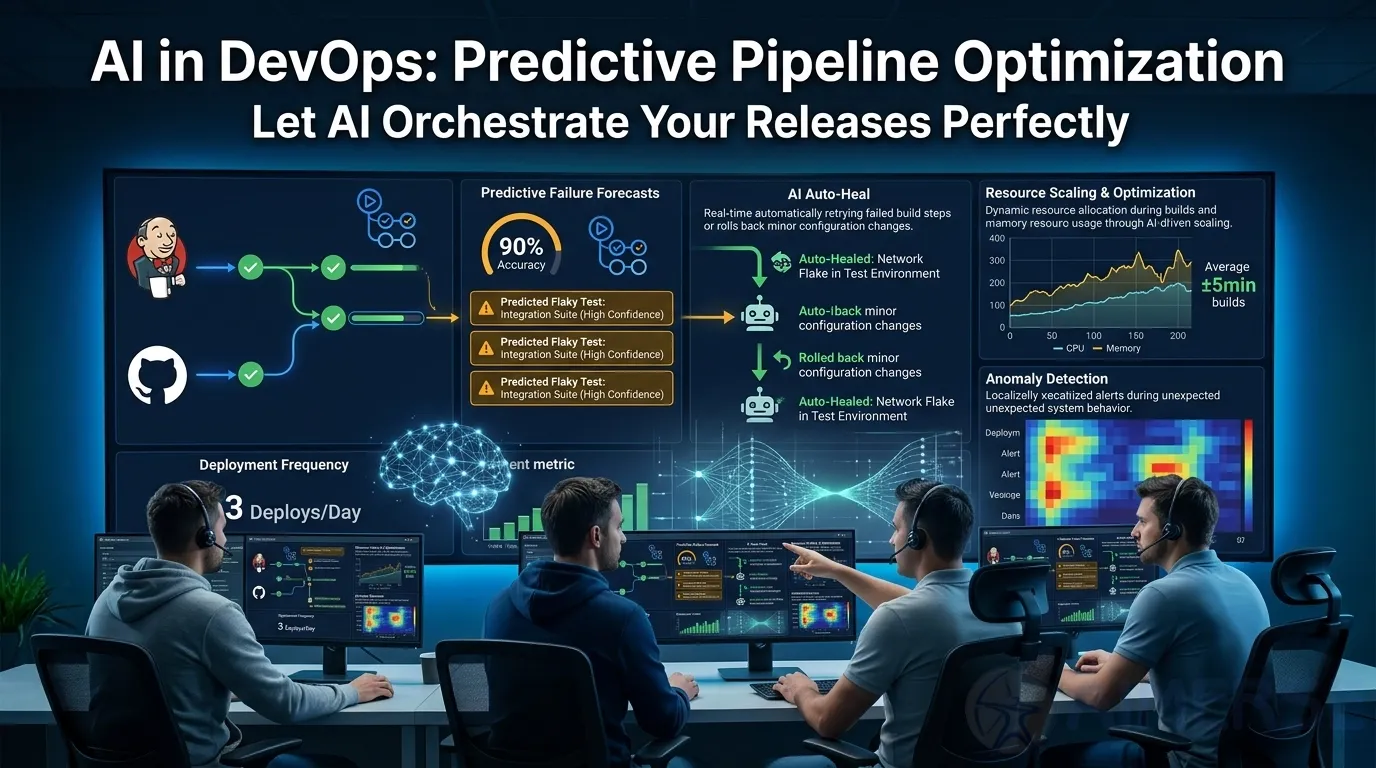
AI in DevOps: Predictive Pipeline Optimization
AI analyzes historical pipelines to predict failures and auto-remediate, cutting deploy times 50% in 2026.
The AI in the DevOps process uses machine learning to analyze the telemetry data from the CI pipeline, such as Jenkins and GitHub, to forecast flake rates with an accuracy of 90%. This allows the teams to prevent approximately 70% of the issues even before they arise. The Harness and Argo tools can also forecast the build times with an accuracy of ±5 minutes, and the agents can also be scaled automatically. Furthermore, the anomaly detection feature can also detect the drifts, and the generative AI can also provide the fixes in plain language. Gartner has also forecast that by the year 2026, 65% of the enterprises will adopt the AI in the DevOps process.
AI Pipeline Features
- Forecasting: Uses time series to forecast the required resources.
- Root Cause: Uses graph neural nets to map the failures across the stages.
- Auto-Heal: Uses self-provisioning runners and rollbacks.
- Optimization: Uses genetic algorithms to optimize the parallelism.
Integrates with Node.js events and Django analytics.
Benefits
- MTTR: Achieves an 80% reduction in the mean time to recover by sending proactive alerts.
- Throughput: Achieves approximately three deploys per day.
- Cost Savings: Achieves approximately a 40% reduction in the infrastructure costs.
- Harness case study: Achieved a success rate of 99.9%.
Challenges
- Data Quality: Requires high-quality data, including synthetic data.
- Explainability: Uses SHAP for explainability.
Strategy
- Instrument the pipelines.
- Train the models over the next six months.
- A/B Test the models.
- Roll out across the enterprise.
Conclusion
By the year 2026, the AI in the DevOps process will be able to anticipate and improve the workflows across the stack, including the use of React.js for metric visualization, Node.js for event intelligence, Python with Django for ML forecasts, Laravel for rapid development, and Java Spring Boot for robust orchestration, thereby making the pipeline prescient in its precision.